
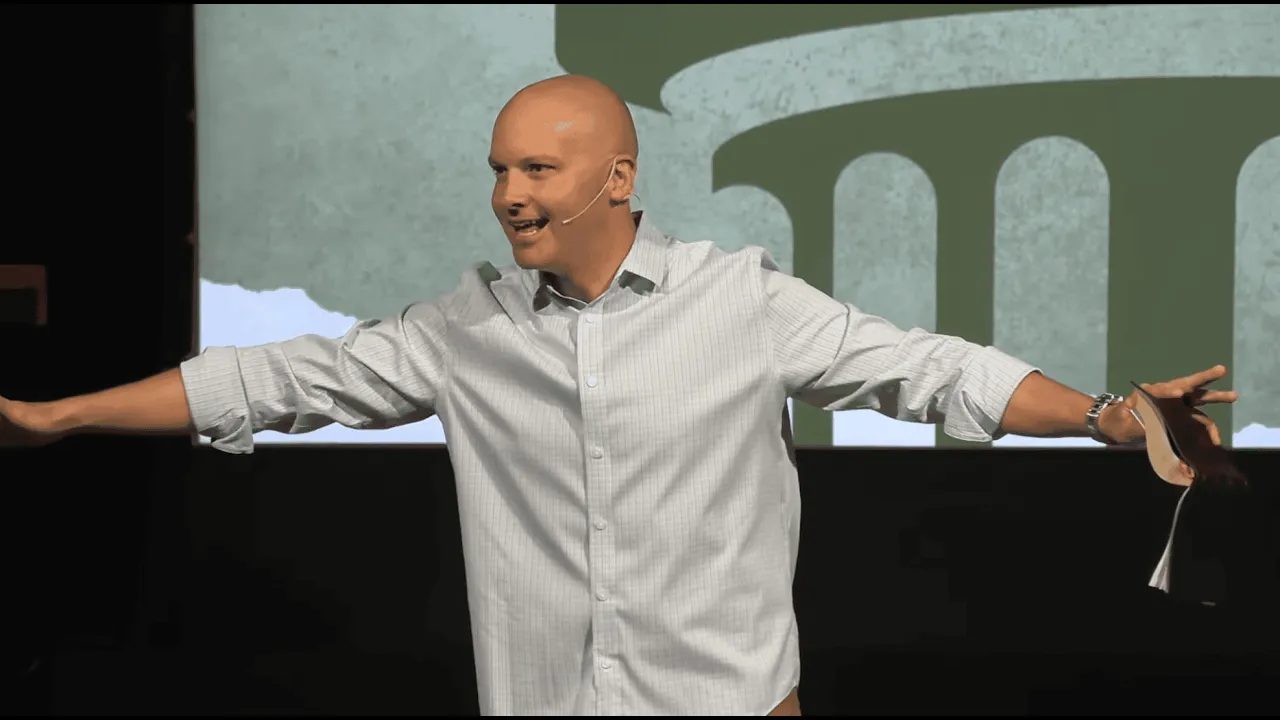
Romans 3:1-26
Preston Dunn
|
Summary:
Worship Set:
Crown Him With Many Crowns
,
Come Thou Fount Come Thou King
,
Who Else
,
In Christ Alone
,
No Longer Slaves
Preaching Manuscript:
In 2003, a 19-year-old Stanford student dropped out of college with a big idea. Elizabeth Holmes said she could take one drop of blood from a fingertip and run hundreds of medical tests on it. This would revolutionize the medical industry with no more need for needles and labs to diagnose health issues. She looked the part. She wore a black turtleneck every day like Steve Jobs, she spoke in a deep, low voice (former employees later said that wasn’t even her normal voice). “We’re going to change healthcare forever.”
The company was called Theranos, and the names behind it were remarkable. She had two former secretaries of state on her board, a former secretary of defense, and a four-star marine general. Walgreens put her machines in its stores. Theranos was valued at $9 billion. Forbes put her on their cover.[^1] With a resume and a story like this, who is going to doubt that the machine would actually work?
Well, it didn’t work. Patients got results that were wrong, and they were living under a false assurance that everything was ok. A misunderstanding of reality. In 2015, the Wall Street Journal exposed the whole thing, Theranos collapsed, and Holmes was convicted of fraud and sentenced to more than eleven years in federal prison![^2]
Everyone who used Theranos to diagnose their health was under a false assurance because of its reputation, but no one was looking at the blood. By all appearances, the machines were working, but on the inside, they were dead.
As we begin chapter 3 in the book of Romans this evening, I want to remind everyone of the context of when and where this letter was written. The Apostle Paul was writing to a group of Christians living in Rome, where he had not yet visited (Romans 1:13). Last week, we took a break to look at how Paul became a Christian, and that before he was a Christian, he was a persecutor of the church (Acts 9:1-2). He looked alive on the outside, but he was dead on the inside. And full of sin. Horrible sin. But he becomes a Christian, and he is completely transformed. These Christians who had moved to Rome had moved from places where Paul had started churches, and they were starting churches in Rome now. This letter is reminding them of the foundations of their faith, and it reminds us of the foundations of our faith. You’ll remember that the Roman Emperor Claudius had exiled all Jewish people from Rome before this letter was written (Acts 18:2),[^3] but Claudius died, and next came Nero. Emperor Nero was the greatest persecutor of Christians of all the Roman emperors who existed,[^4] but he allowed Jews to come back into Rome. So these Christians in Rome were being confronted with all sorts of mixed up theology coming from multiple directions- for one, the culture was steeped in pagan idol worship, and for two, Jewish people who claimed to be God’s chosen people were coming back and telling them they were wrong about their faith. Christ came to fulfill the law (Matthew 5:17). We’re about to see why it is that we had the law in the first place, and what makes a people God’s chosen people. It’s possible to look alive on the outside but be dead on the inside.
So what advantage does the Jew have? Or what is the benefit of circumcision?
–Romans 3:1
Remember that circumcision was the thing that separated the Jewish people from the non-Jewish people. If you don’t know what it is, look it up…in Genesis chapter 17. Remember that Paul was dictating this letter with Tertius, he confirms that in Romans 16 (Romans 16:22), and these next two paragraphs are going to be like a hypothetical debate, picture Paul pacing back and forth while he’s preaching, led by the Holy Spirit, and Tertius is writing furiously.
So what advantage does the Jew have? Or what is the benefit of circumcision? Considerable in every way. First, they were entrusted with the very words of God.
–Romans 3:1-2
These advantages and benefits are considerable, but they are not converting. The Jewish people had been given the law and they were spoken to by God throughout their history, but that does not mean salvation. Think back to Israel’s history- Jehoiakim burned the very words of God (Jeremiah 36:23), Ahab led Israel into Baal worship (1 Kings 16:30-33), Korah rebelled against God’s leader, and the ground swallowed him (Numbers 16:31-33). Just because a person was Jewish does not mean they were saved. And just because a person grows up in a Christian home or goes to church, does not mean they are saved.
What then? If some were unfaithful, will their unfaithfulness nullify God’s faithfulness? Absolutely not!
–Romans 3:3-4
And what is the definition of faithfulness? It’s the keeping of a promise. And what were those promises God made? Well, there was the promise not to destroy the earth by flood in Genesis 9 (Genesis 9:11), there was the land, descendants, and blessing to the nations for His people from Genesis 12 & 15 (Genesis 12:1-3; 15:5-7), there was the promise not to abandon Israel in Leviticus and Deuteronomy (Leviticus 26:44; Deuteronomy 31:6), and most important, there was the promise of the Messiah in 2 Samuel, the prophets, and even Genesis 3 (2 Samuel 7:12-16; Isaiah 9:6-7; Genesis 3:15). God has a special place for Israel. While the church has fulfilled Israel, the church has not replaced Israel. As we march forward through God’s promises, the bulk of them are the promise of the New Covenant. That He will write His teaching on our heart (Jeremiah 31:33), that He will put His Spirit within us (Ezekiel 36:27), and one promise is yet to come in Revelation chapter 7 (Revelation 7:4), when 144,000 of Israel will be redeemed following the rapture of the church, and will play the key role of end-times evangelists to bring multitudes of people to Christ. Our failures can’t cancel God’s faithfulness.
Let God be true, even though everyone is a liar, as it is written: That you may be justified in your words and triumph when you judge.
–Romans 3:4
You know, Romans is quoting Psalm 51 here (Psalm 51:4), which is the Psalm that David wrote after his complete and utter moral failure in committing adultery with Bathsheba and murdering Uriah (2 Samuel 11). You also know that you have committed adultery and murder too, remember Jesus said if you’ve ever looked at a person that isn’t your spouse lustfully, you’ve committed adultery, and if you’ve ever held a grudge, you’ve murdered (Matthew 5:21-28). The very purpose of the law is so that we will realize our total depravity. Our sinful condition that we cannot overcome on our own. We cannot make ourselves righteous on our own.
But if our unrighteousness highlights God’s righteousness, what are we to say? I am using a human argument:
–Romans 3:5
Romans is highlighting what some of its critics claimed was a wrong position of Christianity. That if we’re covered by grace, does that make sin a bad thing? Absolutely it’s a bad thing! And we’ll see why as we keep reading.
Is God unrighteous to inflict wrath? Absolutely not! Otherwise, how will God judge the world? But if by my lie God’s truth abounds to his glory, why am I also still being judged as a sinner? And why not say, just as some people slanderously claim we say, “Let us do what is evil so that good may come”?
–Romans 3:5-8
Romans already gave away the answer to this question by saying this is a slanderous claim. We’ll go deeper on this in Romans chapter 6 (Romans 6:1-2), but anyone who thinks they can continue in sin so that God’s grace will increase is a person who is void of the Holy Spirit, and a person who does not understand the theology of the cross. This passage ends with the theology of the cross, but here’s what you need to know about the type of people who embrace sin.
Their condemnation is deserved!
–Romans 3:8
Our condemnation is deserved. We’re born totally depraved. We’re born into sin (Psalm 51:5). But when we’re saved, we flee from sin! When you’re saved, you’re full of the Holy Spirit. And righteousness has no company with unrighteousness (2 Corinthians 6:14). When you’re a Christian and you sin, which you will, the Holy Spirit guides us out of that sin through conviction (John 16:8). Listen to that Holy Spirit conviction! When you work, when you live, when you vote. We all received ballots this week, and I want to be sure that everyone here is voting for our biblical values. I’ve left my ballot with the biblical value items filled in in our lobby, feel free to take a look at it, and go vote! But when we try to not sin on our own strength, we will fail. When we let the Holy Spirit fill us and guide us, we’re in Christ and our failures will not cancel His faithfulness.
What then? Are we any better off? Not at all! For we have already charged that both Jews and Greeks are all under sin, as it is written:
There is no one righteous, not even one.
There is no one who understands;
there is no one who seeks God.
All have turned away;
all alike have become worthless.
There is no one who does what is good,
not even one.
Their throat is an open grave;
they deceive with their tongues.
Vipers’ venom is under their lips.
Their mouth is full of cursing and bitterness.
Their feet are swift to shed blood;
ruin and wretchedness are in their paths,
and the path of peace they have not known.
There is no fear of God before their eyes.
–Romans 3:9-18
Total depravity. What we just read is an amalgamation of Old Testament Scripture, from the Psalms, Ecclesiastes, and Isaiah (Psalm 14:1-3; 53:1-3; 5:9; 140:3; 10:7; 36:1; Ecclesiastes 7:20; Isaiah 59:7-8), telling us that without the Holy Spirit, we are nothing. Here’s a hot take: the Christian life is not hard. Would you agree with that? The Christian life is impossible, without the transformative work of the Holy Spirit. Look at us, we started this church together with nothing. Just the hope and the vision that can only come from the Lord. And without Him, we’re nothing (John 15:5). In Him, we cannot fail.
Now we know that whatever the law says, it speaks to those who are subject to the law, so that every mouth may be shut and the whole world may become subject to God’s judgment. For no one will be justified in his sight by the works of the law, because the knowledge of sin comes through the law.
–Romans 3:19-20
This is the very purpose of the law: to provide the knowledge that we are born into sin, and the only way out is through Jesus Christ our savior.
Sin is the bad news. God’s wrath is the bad news. Eternal punishment in hell, is the bad news. But next, we’re going to end with the good news.
But now, apart from the law, the righteousness of God has been revealed, attested by the Law and the Prophets. The righteousness of God is through faith in Jesus Christ to all who believe, since there is no distinction.
–Romans 3:21-22
The one way to be made righteous is through faith in Jesus (John 14:6). Your works are only a reflection of the Holy Spirit guiding your life when you believe in Him (Galatians 5:22-25). We can’t fix people, only God can through their faith and trust in Jesus Christ and the indwelling of the Holy Spirit on their life. And in case I hadn’t hammered home our Total Depravity yet, look at this next verse:
For all have sinned and fall short of the glory of God;
–Romans 3:23
We will never be good enough to enter the presence of the Lord, that’s why Jesus came, that’s why God promised the Messiah. That’s why when you read Hebrews 11, you see that the righteous men and women of the Old Testament were made righteous not by their works, but by their faith (Hebrews 11:6).
they are justified freely by his grace through the redemption that is in Christ Jesus.
–Romans 3:24
The redemption that is in Christ Jesus is our atonement. That Christ came to take the place of the punishment deserved by the sin of the whole world.
God presented him as the mercy seat by his blood,
–Romans 3:25
Now in order to understand the significance of the first part of this verse, we have to go back to the 10th day of the 7th month, 1445 BC, Leviticus chapter 16: the Day of Atonement.[^5] On the 10th day of the 7th month of each year, starting in 1445, the high priest would make sacrifices, unblemished animals, to atone for, or to take the place of, the sins of the people (Leviticus 16:29-30). One sacrifice was for the priest’s sins, and one was for the people’s sins. And one animal would live (Leviticus 16:6-10). The high priest would kill the first two animals, and sprinkle the blood of the animals onto the mercy seat (Leviticus 16:14-15), which was the top of the Ark of the Covenant, which was in the Holy of Holies, the innermost part of the tabernacle, and what Israel carried with them everywhere they went, containing the law (Hebrews 9:3-4). That blood represented the atonement of the people, that without the shedding of blood there is no forgiveness of sin (Hebrews 9:22). After the two unblemished animals were sacrificed, the priest would lay hands on the head of the third animal, and he would confess all of the sins of the people (Leviticus 16:21). At the time of Leviticus 16, it’s estimated this would have been about 2.5 million people.[^6] Can you imagine how long that would have taken, and how awful that would have been to do for that priest? To confess every sin for 2.5 million sinful people? He would lay hands on that unblemished animal, and confess the sins of 2.5 million people. And then the animal was sent to the wilderness to live (Leviticus 16:22).
Jesus Christ was the unblemished lamb (1 Peter 1:19), and he was the mercy seat. We no longer require a priest, Christ made us a priesthood of believers (1 Peter 2:9). In Christ, we confess our sins directly to Him (1 John 1:9). When He was crucified, the untearable temple veil was torn from top to bottom (Matthew 27:51),[^7] fulfilling this Old Testament sacrificial system. God made the one who knew no sin to be sin for us, so that in him we might become the righteousness of God (2 Corinthians 5:21).
We talk often about the excruciating death that Christ died for our sins on the cross. And that’s what it was, it was the worst possible way for a person to die, was the way Jesus died, for you, and for me. But one part of Christ’s death that often gets neglected is our sin. Do you remember the night when Jesus was betrayed, the night before his crucifixion, he was praying in the Garden of Gethsemane? He said, “My Father, if it is possible, let this cup pass from me. Yet not as I will, but as you will” (Matthew 26:39). Jesus was talking about the cup of God’s wrath (Isaiah 51:17; Jeremiah 25:15). Not only did Jesus Christ die an excruciating death, that’s not all that the cross is about. While Jesus was dying, and he hung on that cross for six hours (Mark 15:25, 34), he was drinking the cup of God’s wrath for all of the sins of the world. All of them, every person, whether they become Christians or not. 1 John 2:2 says:
He himself is the atoning sacrifice for our sins, and not only for ours, but also for those of the whole world.
–1 John 2:2
If anyone tries to tell you that Christ’s atonement is limited to a pre-selected few, that is a mixed up theology derived from John Calvin that I believe was sent to stunt evangelism.[^8] Jesus was the atoning sacrifice for the whole world. Now picture all of your sin. Picture it. Every sin you’ve ever committed and are yet to commit. Every sin your lost neighbor, your lost boss, your lost enemies, have ever committed or will commit. They’re poured out and drank by Jesus, during his excruciating death, for all of us. And when people reject Him, they’re rejecting what He did for them (John 3:18). And they will experience God’s wrath in hell as a result. There is one way to heaven:
through faith, to demonstrate his righteousness, because in his restraint God passed over the sins previously committed. God presented him to demonstrate his righteousness at the present time, so that he would be just and justify the one who has faith in Jesus.
–Romans 3:25-26
For the wages of sin is death, but the gift of God is eternal life in Christ Jesus our Lord.
–Romans 6:23
6 years ago there was a woman. A 38 year old single mother named Kristina Stratton who was raising five kids alone. Her husband had died of brain cancer about four years earlier. One night, she was out with one of her daughters, her other children were at home asleep upstairs. She came home to her house on fire. She was outside, she was safe, no one would have blamed her if she stayed outside and waited for the fire trucks. But her children were inside. Rather than watch them burn, she ran inside to find them. By the time she made it upstairs, she was mortally burned. She made it upstairs, fashioned a way out of the house through the window, and saved her children one by one through a window. But Kristina did not make it out of the house. By the time the firefighters found her, she was dead. Her sister, Sarah, who took custody of the children, put it this way: “She did what any parent would do, she protected her children.”[^9] In Kristina’s case, it cost her her life. Jude 23 tells us to save others by snatching them from the fire, that’s what Jesus did for us. As Christians, it’s common to simplify the gospel too much. Jesus died for our sins (1 Corinthians 15:3). No. Jesus suffered an excruciating death and drank the cup of God’s wrath on that cross for everyone. And if you don’t accept the gift of salvation, you’re going to burn in the house of sin forever. I hope this does two things for us when we leave here tonight: 1. That we have an unfathomable appreciation for the sacrifice that Jesus made for us in order to save us, and 2. That we leave with a burden and an urgency to share our faith with others because they are burning in the house of sin when Jesus already paid the price for them. All they have to do is accept His offer to follow Him. That on that cross where Jesus dies, the wrath of God was satisfied.[^10]
[Invitation]
[Communion] Do you grasp the cross?
Footnotes:
[^1]: John Carreyrou, Bad Blood: Secrets and Lies in a Silicon Valley Startup (New York: Alfred A. Knopf, 2018).
[^2]: John Carreyrou, "Hot Startup Theranos Has Struggled With Its Blood-Test Technology," The Wall Street Journal, October 15, 2015
[^3]: Suetonius, The Lives of the Twelve Caesars, "Claudius" 25.4.
[^4]: Tacitus, Annals 15.44.
[^5]: Date follows the early-Exodus chronology based on 1 Kings 6:1; see Eugene H. Merrill, Kingdom of Priests: A History of Old Testament Israel, 2nd ed. (Grand Rapids: Baker Academic, 2008).
[^6]: Estimate extrapolated from the census of 603,550 men twenty years old and up in Numbers 1:46 (cf. Exodus 12:37).
[^7]: Mishnah Shekalim 8:5 (on the thickness of the temple curtain).
[^8]: Limited Atonement was formalized in the Canons of Dort (1618–1619), Second Main Point of Doctrine; and derived from but not originating from John Calvin's Institutes of the Christian Religion (1559).
[^9]: "Bodies of Two Rescuers Were Found Together After Fire," The Bakersfield Californian, February 11, 2019, https://www.bakersfield.com/news/bodies-of-two-rescuers-were-found-together-after-fire-community/article_b4fe695c-2e45-11e9-a1d7-5f74a14c2658.html; "Kristina Stratton Died Saving Her Children From Fire," WTVR, February 9, 2019, https://www.wtvr.com/2019/02/09/kristina-stratton-died-saving-her-children-from-fire. Note: source for the sister's quote not yet located.
[^10]: Keith Getty and Stuart Townend, "In Christ Alone" (Thankyou Music, 2001).
