
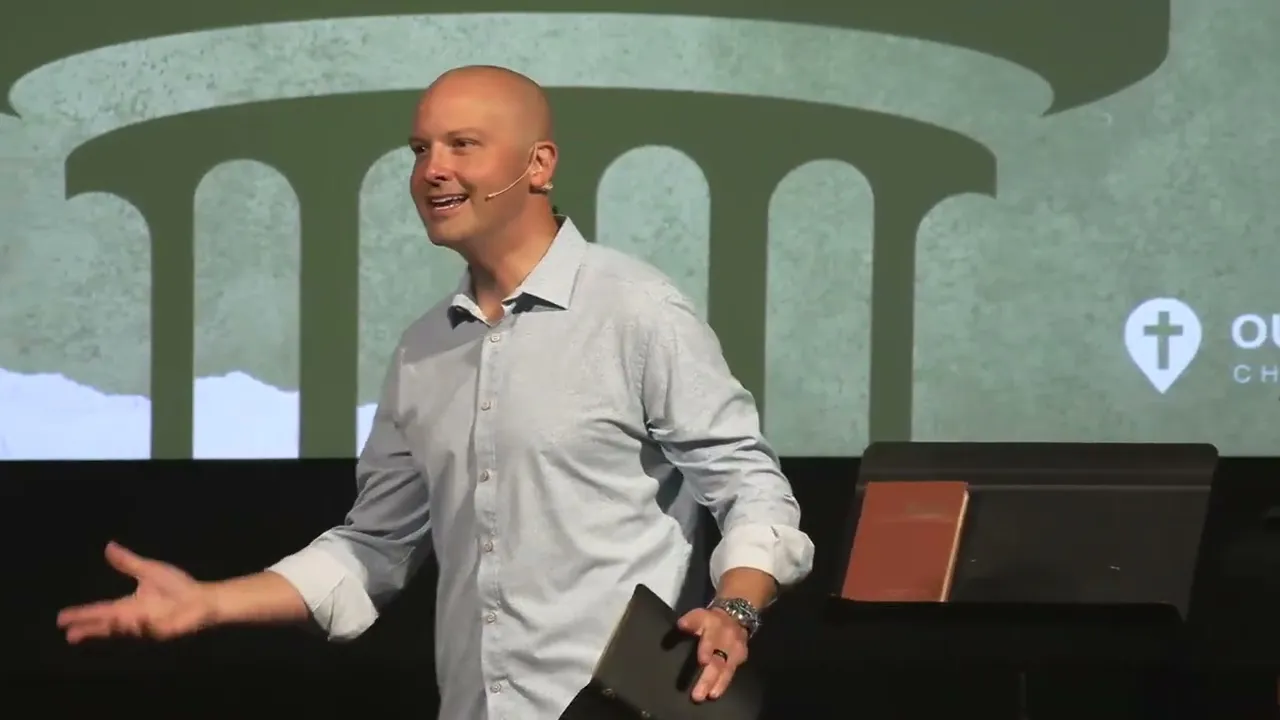
Romans 3:27-4:5
Preston Dunn
|
Summary:
Worship Set:
Doxology
,
Battle Belongs
,
Amazing Grace
,
King Of Kings
,
Gratitude
,
Love of God
Preaching Manuscript:
On August 5, 2010, a mountain collapsed inside the San Jose copper mine in Chile. 33 men were trapped more than 2,000 feet underground. There was no way out, no way to call for help, and almost no food. For 17 days, the world assumed they were dead. But then, a drill punched through the rock where they were sheltering. When it came back up, there was a note taped to it in red ink: We are fine in the shelter, the 33. They were alive, but being alive is not the same as being rescued.
What happened next was one of the biggest rescue efforts in history. Engineers from Chile, drillers from America, and advisors from NASA spent weeks boring a half-a-mile shaft through the solid rock. They built a steel capsule called the Phoenix, barely wider than a man’s shoulders.
Just after midnight, a billion people watched the first miner, Florencio Avalos, step into the capsule. Fifteen minutes later, he came up into the night air, into his little boy’s arms. All 33 men were rescued, every one of them came out alive.[^1]
Now think about what those men did to be rescued. They didn’t drill the shaft or design the capsule, they didn’t pay for any of it, they couldn’t have. The one thing they did to get rescued, was get in.
And here’s the other side of it. If they refused to get in, they would have died down there, with a finished rescue effort right above them! No one was celebrating the effort of the miners, they were celebrating the effort of the ones who saved those miners, and they were celebrating that those 33 miners were saved.
I wanted to share this story with you to articulate the main point of tonight’s passage: Faith is not the cause of salvation. Faith is the means of salvation. The cause of salvation, that’s what makes salvation “go” is God’s grace and mercy. The means of salvation, or what we need to do to get into the rescue that God built for us, is faith.[^2]
Just like those miners didn’t come out of the ground cheering for themselves, they came out from the ground celebrating the ones who saved them. We begin tonight by learning that we have nothing to brag about.
Where, then, is boasting? It is excluded. By what kind of law? By one of works? No, on the contrary, by a law of faith. For we conclude that a person is justified by faith apart from the works of the law.
–Romans 3:27-28
Remember that the Old Testament law had a purpose to point us to our need for a Savior (Galatians 3:24). Jesus came to us because we are not capable of keeping that Old Testament law. And as it turns out, salvation was about faith the entire time! We’re about to get in to some information about Abraham, and I want to catch you up on him before we do. When you read about Abraham in the New Testament, the New Testament does not have one negative thing to say about him. When Abraham’s faith is remembered in the books of Acts, Romans, 2 Corinthians, Galatians, Hebrews, James, and 1 Peter, the New Testament only speaks positively about this man (Acts 7:2–8; Romans 4; Galatians 3:6–9; Hebrews 11:8–19; James 2:21–23). But when you read the account of his life in Genesis, you learn about a man who failed. Over and over again. He gave up his wife to foreign kings twice (Genesis 12:10–20; 20:1–18), he had a son with a woman who wasn’t his wife (Genesis 16:1–4), he lied, he laughed at God’s promise (Genesis 17:17). But do you know what he had? Faith. And the same God who counted Abraham as righteous because of his faith, is the same God who counts you righteous because of your faith. Our failures can’t cancel God’s faithfulness. And He is the Lord of all.
Or is God the God of Jews only? Is he not the God of Gentiles too? Yes, of Gentiles too, since there is one God who will justify the circumcised by faith and the uncircumcised through faith. Do we then nullify the law through faith? Absolutely not! On the contrary, we uphold the law.
–Romans 3:29-31
As Christians, we’re compelled to do the things that God is asking us to do because the Holy Spirit guides us when we’re saved by faith. If you’re not full of the Holy Spirit, it’s up to you. When you’re full of the Holy Spirit, it’s up to Him. When it’s up to you, you will fail. When it’s up to Him, you will prevail. Just look at this example of Abraham:
What then will we say that Abraham, our forefather according to the flesh, has found? If Abraham was justified by works, he has something to boast about—but not before God.
–Romans 4:1-2
Many commentators take this verse to imply that, even if he was justified by works, he still had no ground of glorying before God, though he might have before men.[^3] Remember Isaiah 64:6 says that our righteous deeds are like filthy rags.[^4]
For what does the Scripture say? Abraham believed God, and it was credited to him for righteousness.
–Romans 4:3
I want to camp out on this verse for a moment. Abraham believed God, and it was credited to him for righteousness. You’ll notice that this verse in your Bible is bold, and you’ll also notice a footnote at the end of it that says Genesis 15:6. What was it that Abraham believed about God? Was it that he believed that God exists? No, not just that, remember that James 2:19 says that even the demons believe that God exists, and shudder. Abraham believed the promise of God. Take your Bibles and turn back to Genesis 15 with me, and let’s read what it says.
The word of the LORD came to Abram in a vision: Do not be afraid, Abram. I am your shield; your reward will be very great. But Abram said, “Lord GOD, what can you give me, since I am childless and the heir of my house is Eliezer of Damascus?” Abram continued, “Look, you have given me no offspring, so a slave born in my house will be my heir.” Now the word of the LORD came to him: “This one will not be your heir; instead, one who comes from your own body will be your heir.” He took him outside and said, “Look at the sky and count the stars, if you are able to count them.” Then he said to him, “Your offspring will be that numerous.”
Abram believed the LORD, and he credited it to him as righteousness.
–Genesis 15:1-6
God had already promised Abraham the land, that He would make him into a great nation, that he would make his name great, that those who bless him would be blessed, those who curse him would be cursed, and that all the people of the earth would be blessed through him (Genesis 12:1–3, 7).
God’s promises build throughout the Bible. God has promises that He has made to you.
For one, God promises that He will keep His word. As evidence by every promise He made throughout the Old Testament which came true, and as evidenced in your life as a Christian. 2 Corinthians 1:20 says For every one of God’s promises is “Yes” in Him. Therefore, through Him we also say “Amen” to the glory of God. When we pray for God’s will, He answers that prayer 100% of the time (1 John 5:14). Just know that sometimes God’s answer is not the answer we might have been looking for. Remember that old country song, “I thank God for all the unanswered prayers”?[^5] Well that’s not completely accurate, every prayer is answered, but God knows what we need better than we know what we need. The word “Amen” means “it is sure.”[^6] And as Christians, we are sure that God’s plans are the best plans for our lives, even when they look different than we thought they would.
For two, God promises provision. Hebrews 13:5 instructs us to "Keep your life free from the love of money. Be satisfied with what you have, for he himself has said, I will never leave you or abandon you." You know what’s interesting about this verse? The word “love” isn’t a standalone word in the original Greek text, translators chose to say it this way to make it understandable, but the original Greek uses a word that means “free from covetousness.”[^7] Free from coveting and being content with what you have. Be satisfied with what you have. God will provide. When Jesus preached in Matthew, He told us to look at the sparrows, do they worry about where their next meal will come from? How much more will your Heavenly Father take care of you? (Matthew 6:26; 10:29–31) And this promise to never leave us or forsake us is repeated throughout the Old Testament and the New Testament (Deuteronomy 31:6; Joshua 1:5; Matthew 28:20). God will provide.
For three, God promises to guide us. In John 16:13, Jesus promised to guide us in His Spirit. When the Spirit of truth comes, He will guide you into all truth. This promise to guide us applies to our entire lives. The way we love our spouses, the way we parent our children, the way we build friendships, the way we work at our jobs. I want to speak to each of these briefly, because I have a feeling we all could use some encouragement in each of these areas. For one, our marriages. Scripture says that wives are to submit to their husbands, and husbands are to love their wives as Christ loves the church (Ephesians 5:22–25). Think about that. You know, the root of most marriage issues come from the husband not feeling respected, and the wife not feeling loved. I read that in a book called Love & Respect, Brittany and I read it together, highly recommended.[^8] But when the Husband is head of his wife like Christ is head of the church (Ephesians 5:23), the only way marriage will work is by the guiding of the Holy Spirit. The unconditional love that Christ has for His church that is reflected in the covenant of marriage. It only works when the Holy Spirit is guiding it. Read through any Church History textbook and you’ll see failures that are worse than Abraham’s. But God delivers us in spite of our failures. That’s how marriage works. Husbands will fail, wives will fail, but the Holy Spirit does not fail.
Same with the parenting of our children. In Isaiah 44:3, God promises He will pour out His Spirit on our descendants and His blessing on our offspring. Our children are born into sin (Psalm 51:5). You don’t have to teach a child to lie, you have to teach a child not to lie. You don’t have to teach them to lose their temper, you have to teach them not to lose their temper. But there is a great demarcation in every person’s life. The time before they are full of the Holy Spirit, and the time after they are full of the Holy Spirit. When our children are full of the Holy Spirit and we are full of the Holy Spirit, the Spirit guides us, and our children, into truth. It would be impossible for me to parent without the work of the Holy Spirit guiding me and my children, and the same is true for you.
Last, I want to touch on God’s promises for His provision and the place where you work. Ephesians 6:7-8 tells us to work with a good attitude, as to the Lord and not for people, knowing that whatever good each one does, he will receive this back from the Lord. I know a number of you are struggling with your jobs. Know that no matter how bad your boss is, no matter how disrespectful your customer is, no matter how mind-numbing the work might be, God has promised you that you will receive eternal rewards for the way you are reflecting Him when you do your job. Hold on to that promise.
And the ultimate promise from God for the Christian is eternal life. That when you’re made righteous through your faith and trust in Christ and His promises, you will not die, you will live with the Lord forever. This is the promise for Christians, not a promise for non-Christians. Non-Christians are eternally separated from God in hell, a place that was built not for people but for Satan and his demons (Matthew 25:41).
I lost my grandmother this week here on earth. I got the call, when I was in the middle of this text. She was almost 95 years old. She was such a joyful woman. She was losing a battle with dementia. She could tell you all the details of memories we had from 30 years ago, but she couldn’t remember what happened 10 minutes ago. I reflect on this and realize how important it is to build core memories with the people we love, just in case any of us gets dementia, we’ll have plenty to talk about! When I would tell her about Our City Church, she would always say “You’re singing in the choir, right?” When I told her we won’t have a choir, she was always disappointed because she was hearing it for the first time. It was endearing for sure.
I wept when I learned she died, even Jesus wept when His friend Lazarus died (John 11:35). Grief is hard, no question about it. But losing a loved one does not change God’s promise that when we are in Him, we don’t actually die. We are absent of this body, but we are present with the Lord (2 Corinthians 5:8). And that is God’s ultimate promise, that we will be with Him forever. We will be His people, and He will be our God (Revelation 21:3). This is not something you can earn, it is something you can only receive. We close our text in Romans this way:
Now to the one who works, pay is not credited as a gift, but as something owed. But to the one who does not work, but believes on him who justifies the ungodly, his faith is credited for righteousness.
–Romans 4:4-5
I was in this text with our fourth graders at Acts Academy this week. I asked them, if I paid them $20 to mow my lawn, is that $20 a gift? No! It was earned. But if I asked them to mow my lawn, they tried to get there, failed to get there because something came up, they didn’t show up, and I gave them $20 anyway, is that a gift? Absolutely. You see, we can try all we want to work our way into salvation, but something will always come up: sin. We’ve all sinned. Our righteous works are like filthy rags. But God gives us the gift of salvation. Just like the miners from the beginning of this message. They didn’t drill the rescue hole, they didn’t build the escape pod, they didn’t organize the rescue effort. They just got into the pod. If you’re here tonight, and your marriage is failing, your parenting is failing, your job is failing, your relationships are failing, the promise God has made you is that you are not capable of being righteous. But He is. And where God guides, God provides. God will guide you by the work of His Spirit. When Jesus died on the cross for your sins, He said “It is finished” (John 19:30). He has already done the work. Your faith in His promises is the means that He will use to guide you into truth.
The last time I was able to visit my grandmother in her home, she gave me this old hymnal. I picked it up yesterday and noticed this page was bookmarked and written on. I read the familiar words to this classic hymn, and realized how relevant it is to conclude our message tonight:[^9]
All the way my Savior leads me;
What have I to ask beside?
Can I doubt His tender mercy,
Who through life has been my Guide?
Heav’nly peace, divinest comfort,
Here by faith in Him to dwell!
For I know, whate’er befall me,
Jesus doeth all things well.All the way my Savior leads me,
Cheers each winding path I tread,
Gives me grace for every trial,
Feeds me with the living bread.
Though my weary steps may falter,
And my soul athirst may be,
Gushing from the Rock before me,
Lo! a spring of joy I see.All the way my Savior leads me;
O the fullness of His love!
Perfect rest to me is promised
In my Father’s house above.
When my spirit, clothed immortal,
Wings its flight to realms of day,
This my song through endless ages:
Jesus led me all the way.
Footnotes:
[^1]: “2010 Chilean Mine Rescue Fast Facts,” CNN, accessed October 14, 2026, https://edition.cnn.com/2013/07/13/world/americas/chilean-mine-rescue.
[^2]: Edwin A. Blum, “Romans,” in CSB Study Bible: Notes, ed. Edwin A. Blum and Trevin Wax (Nashville, TN: Holman Bible Publishers, 2017), 1785.
[^3]: H. D. M. Spence-Jones, ed., The Pulpit Commentary: Romans, The Pulpit Commentary (London; New York: Funk & Wagnalls Company, 1909), 108.
[^4]: Isaiah 64:6. The CSB reads, “all our righteous acts are like a polluted garment” (CSB); “filthy rags” is the familiar King James wording.
[^5]: Garth Brooks, “Unanswered Prayers,” (Capitol Nashville, 1990). The wording in the sermon is a paraphrase of the song’s chorus.
[^6]: “Amen” comes from a Hebrew root meaning “to be firm, reliable, sure”; spoken at the end of a prayer or statement, it means “so it is” or “let it be so.” See Walter Bauer, A Greek-English Lexicon of the New Testament and Other Early Christian Literature, 3rd ed. (Chicago: University of Chicago Press, 2000) (hereafter BDAG), s.v. “ἀμήν.”
[^7]: The Greek word in Hebrews 13:5 is ἀφιλάργυρος, it is a compound of a- (“not”), phil- (“fondness”), and argyros (“silver, money”); The King James Version renders it “without covetousness,” and the CSB “free from the love of money.” See BDAG, s.v. “ἀφιλάργυρος.”
[^8]: Emerson Eggerichs, Love & Respect: The Love She Most Desires; The Respect He Desperately Needs (Nashville: Integrity Publishers, 2004).
[^9]: Fanny J. Crosby, “All the Way My Savior Leads Me” (1875)
